Today's blog is on the Oceanic Whitetip shark(Carcharhinus longimanus), This shark can be recognized by its round fins topped with white and by their small body and their short broadly snout. They can grow to by 300 cm and even larger in rare cases. They use their powerful jaws to grip and tear their prey apart their lower jaw with its pointed teeth are used for griping on to their prey and their upper serrated teeth are used to rip their prey in to pieces these teeth are broader and serrated. They were first discovered of the coast of Brazil in 1992 this shark was most likely caught in a fishing net on accidentally by a local fishery, keep in mind this large shark can be found around the world and is a threat to humans however most attacks are not fatal and are caused out of the sharks curiosity and not on purpose. If you reader of my blog would like to learn more about this creature then cheek out the links below.
Friday, January 29, 2016


Tuesday, January 5, 2016
Pigeye Shark (Carcharhinus amboinensis)
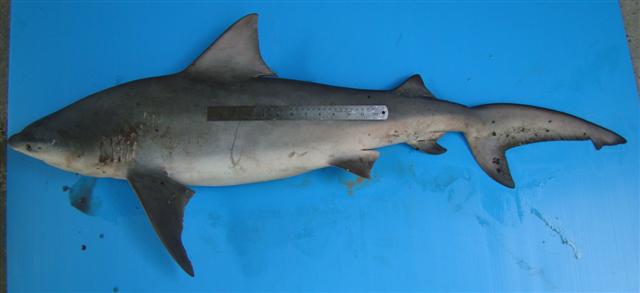
Today's blog will be on the Pigeye Shark/ the Carcharhinus Amboinensis, This shark can be recognized by it's small eyes and its large dorsal fin and black markings on the undersides of the pectoral fins, they can also be recognized by their short rounded snout.
They can reach sizes from
They can reach sizes from
60 to 280 cm.This shark gets it's name from it's short snout
and small eyes like a pig, This shark has not be proven to be a threat to humans.
The females are known to be larger than the males the females also give birth from 3 to 13 pups witch are 43 to 53 cm in length. They usually hunt on the ocean floor and eat small fish like flat heads and croakers they are also known to eat dolphins and sea snakes.
 |
| map showing distribution inshore and offshore of Brisbane. |
The females are known to be larger than the males the females also give birth from 3 to 13 pups witch are 43 to 53 cm in length. They usually hunt on the ocean floor and eat small fish like flat heads and croakers they are also known to eat dolphins and sea snakes.
 |
| diagram of the Pigeye Shark |
 |
| Pigeye tooth |
Tuesday, December 15, 2015
Sandbar Shark (Carcharhinus Plumbeus)
 Today's blog will be on the Sandbar Shark/ the Carcharhinus Plumbeus, This shark is one of the largest coastal sharks they are one of the most common shark species swimming along the Atlantic coast. Another name for this shark is the brown shark the shark got it's common name from it's habitat and it's name in Greek translates to "sharpened nose of lead". You can identify this shark by it's large dorsal fin and round blunt nose along with it's tan like color and large gold and black eyes and a graceful swimming patterns. This shark has be reported to attack humans but most attacks are not fatal so this shark is not considered to be dangerous but will still attack if you get to close. The largest this shark can get is 2 m or 6.5 feet long and weigh 45 kg (100 lb) to 90 kg (200 lb. Their diet is mostly made up of small bonny fish and even octopus along with small hard shellfish like crab and shrimp however they mostly hunt at night. during they'er breeding mostly takes place in the early summer in the northern hemisphere and in the southern hemisphere during the early fall up to winter they can give berth to 6 to 13 pups during this period.
For more information on this shark click on the links below
http://www.aquariumofpacific.org/onlinelearningcenter/species/sandbar
FLMNH Ichthyology Department: Sandbar Shark
Sandbar shark swimming - ARKive

Monday, November 9, 2015
Mexican Beaded Lizard/ Heloderma Horridurm
 |
Today's blog will be on the Mexican beaded lizard, this lizard like the Gila monster is poisonous and is one of the 2 poisonous lizards in the world. This lizard is in the same family as the Gila monster and they are both similar in appearance, However the Gila monster is smaller and more colorful compared to the Mexican beaded lizard. The beaded lizard spend most of their time in a burrow in their remote habitats, both the Gila and beaded lizard are sole survivors of and ancient group of lizards called the monstersauria. Both the Gila and beaded lizards do not make good pets because of their venomous bite however some people do keep them as pets but after certain requirements are meet in certain country's for more info on that search it online. They mostly eat eggs of birds and lizards along with snake eggs and even small animals like mice, The largest they can get is 40 in (101 cm) and weigh 5 pound the average age is 30 to 50 years in the wild and 40 in captivity. As the name suggest they live in Mexico but have been found in Arizona. If you reader would like to know more then you can search the web.

Monday, November 2, 2015
Banded Gila Monster / Heloderma suspectum cinctum
 Today's blog is on the Banded Gila monster, This lizard can be found in the deserts of southwestern united states and northwestern mexico. Their habitat is mostly desert areas with dead trees and shrubs they also can be found on mountain slops. This lizard is one of the 2 venomous lizards in the world The other is the Mexican bearded lizard , They use this venom in defense rather than to subdue prey the venom is introduced through the lizards bottom jaw form venom glands in the lower jaw, Their the teeth on the bottom jaw are just as nasty they have groves that are designed to do damage the flesh of their victim. They are a threatened species and they have a chance of going extinct this is because of urban development and agriculture, Also the illegal capture of these animals and they are sold on the black market as pets.

This lizard lays from 3 to 12 eggs during the late spring in their shallow nests dug into the ground, If you find a nest do not disturb it and know that the mother or father are near by watching ready to attack if they see you as a threat to the nest.

This lizard can grow up to be 20 inches long and weigh up to 5 to 10 pounds.
They can be identified by the pink and black bands on their tail.
Fun Facts
-The Gila monster is immune to it's own venom
-Gila monsters can live up to 20 years
-The Gila monster is named after the Gila Basin in Arizona
Wednesday, October 28, 2015
West Africa mud Turtle

Today's post will be of the African mud turtle, as the turtle's name suggests they can be found throughout west Africa in swamps, ponds, rivers, and mud holes. During the dry season the dig into the ground and wait for the wet season to come. They are usually found in large numbers on the muddy banks.This turtle hunts With it's sharp claws and they also can be used for climbing up steep slopes. This turtle is quite common and appeared 120 million years ago making them one of the most primitive turtle species on earth today.They are a medium size turtle species and can grow form 7-11 inches but some reach 12 inches. They have been known to reach 50 in captivity and could live longer in the wild, Now if you are wondering if you can have them as a pet the answer is yes the best way on keeping them healthy is to put them in a pond like area that is mostly water and only 25% land do this in a 10x10 enclosure with a roof and walls that should go 6-12 inches below the ground.
For more Information watch video
Monday, October 19, 2015
Whale Shark/Rhincodon typus

Today's blog will be on the whale shark/ Rhincodon Tyous, The whale shark is a slow moving filter/eater similar to a whale. This species originated 60 million years ago. They can be found in tropical open waters along the equator and are rarely found in waters below 71 °F, They are thought to live up to 70 years but keep in mind that this is not an accurate measurement they may live longer or not. The species was distinguished in April 1828 when a 4.6 m long specimen was harpooned in Table Bay, South Africa by a military officer with the British troops posted in Cape Town his name was Andrew Smith The following year he named it the whale shark. They can be recognized by the spots on its back it's white belly and the flat snout with small black eyes, the mouth of the whale shark contains up to 300 to 350 rows of teeth and 10 filter pads, They also have five large gills the average size of an adult whale shark is around 9.7 m they can weigh up to 9 tons. There has been sightings of whale sharks that are twice the size of an average adult that are 18 m long and weigh 18 tons. They feed on plankton and krill but sometimes can accidentally swallow a whole human or fish also they can be friendly unless they have their young near them how ever most whale shark are friendly and allow humans to ride on their backs but watch out for their tails because one hit can kill a man.
 |
Subscribe to:
Posts (Atom)